


 Last updated: May 15, 2026
 Content reviewed by: Research & Immigration Content Team – KOSAM LLC Verification: Benchmarked against the USCIS Policy Manual and recent adjudication trends.
For Lawful Permanent Residents (LPRs or Green Card holders) in the United States, bringing family members to achieve the American Dream is a top priority. However, U.S. immigration law enforces strict, rigid age-based classifications. Many parents face intense uncertainty when their children cross the threshold into adulthood.
Can a Green Card holder sponsor a child over 21? How long does the F2B visa process take, and what critical eligibility requirements must be met to prevent the immediate revocation of your petition?
This comprehensive guide references the U.S. Immigration and Nationality Act (INA) and the latest Visa Bulletin data from the U.S. Department of State to deliver definitive answers for international families.
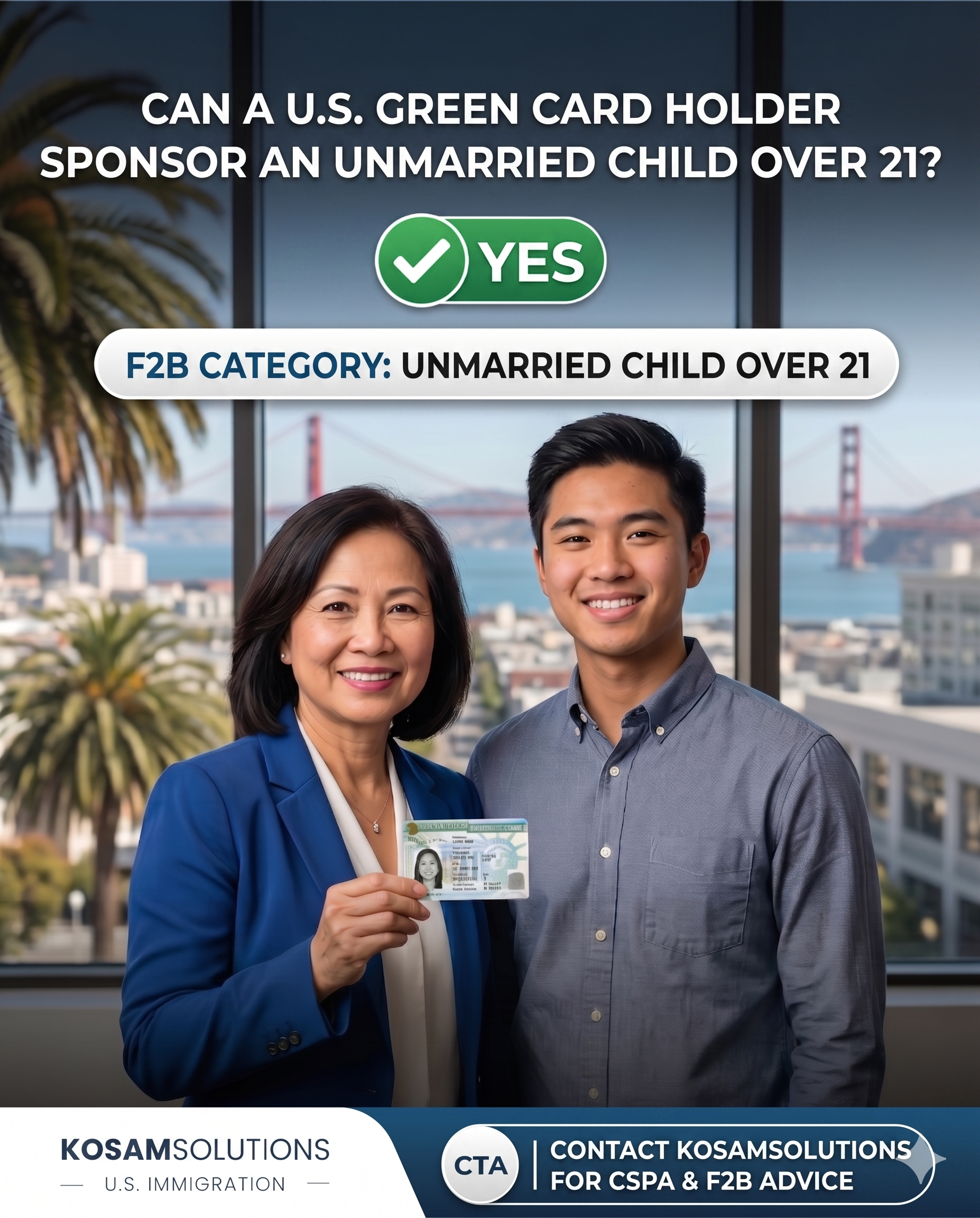
1. Can a Permanent Resident Sponsor an Adult Child Over 21?
From a legal standpoint, the U.S. Citizenship and Immigration Services (USCIS) answers: YES, YOU ABSOLUTELY CAN.
However, the petitioner’s legal status—as a Lawful Permanent Resident (Green Card holder) rather than a U.S. Citizen—strictly confines the adult child’s eligibility to a single, specific family-sponsored preference category: The F2B Preference Category (Unmarried Sons and Daughters, 21 Years of Age or Older, of Permanent Residents).
Unlike the F2A category (reserved for spouses and unmarried children under 21), the F2B category is governed by strict annual statutory caps (quotas) mandated by the U.S. government. Consequently, beneficiaries cannot receive an immigrant visa immediately upon USCIS petition approval. Instead, families must navigate a chronological queue determined by their specific placement in line.
2. Fatal Eligibility Requirements to Maintain an F2B Petition
The F2B visa category is highly sensitive and prone to catastrophic legal risks if families fail to track shifting marital statuses. Two core conditions dictate the continuous validity of the entire file:
Marital Status: The Absolute Requirement to Remain UNMARRIED
The sponsored individual (the son or daughter) must continuously maintain their unmarried status throughout the entire lifecycle of the case. This restriction applies from the initial filing of Form I-130 until the moment they physically clear U.S. Customs and Border Protection (CBP) as an arriving permanent resident.
-
Legal “Unmarried” status is defined as: Never married, legally divorced (with a final, absolute judicial divorce decree), or widowed.
The Risk of Mid-Process Marriage: A Total Petition Revocation
⚠️ RED FLAG UNDER U.S. IMMIGRATION LAW:
Lawful Permanent Residents DO NOT possess the legal right to sponsor a married child. If an F2B beneficiary signs a marriage certificate while the petition is pending, the underlying Form I-130 is IMMEDIATELY AND AUTOMATICALLY REVOKED by operation of law. There are no grandfather clauses, no grace periods, and no alternative permanent resident categories to salvage the file.
The Only Legal Remedy if a Child Must Marry: The sponsoring parent in the U.S. must successfully naturalize and become a U.S. Citizen. Once naturalized, the parent can request that the pending or approved F2B file be upgraded and converted into an F3 category petition (Married Sons and Daughters of U.S. Citizens). Be aware that the wait times will adjust to match the statutory caps and backlogs of the F3 queue.
3. Latest F2B Visa Wait Times: May 2026 Bulletin Adjustments
Because the volume of global F2B applications consistently eclipses the annual allocation limits, the U.S. Department of State regulates the flow of visas via the monthly Visa Bulletin.
Based on the May 2026 Visa Bulletin, the average wait time for an F2B visa for applicants from standard worldwide countries (including Vietnam) spans roughly 8 to 9 years. This timeline demands long-term planning and patience from families.
To gauge your exact timeline, cross-reference the Priority Date printed on your Form I-797C (Notice of Action) receipt against these two distinct processing charts:
Chart B: Dates for Filing (When to Assemble Documents)
-
Current Cut-off Date: January 01, 2018.
-
Operational Meaning: Only F2B petitions featuring a Priority Date established before January 01, 2018, are authorized by the National Visa Center (NVC) to pay statutory fees, submit Form I-864 (Affidavit of Support), and upload civil documents.
Chart A: Final Action Dates (When a Visa Can Be Issued)
-
Current Cut-off Date: May 22, 2017.
-
Operational Meaning: Only petitions with a Priority Date landing before May 22, 2017, have reached the front of the queue. These applicants are eligible to have their interviews scheduled at their local U.S. Consulate or Embassy, or to have their Form I-485 Adjustment of Status applications adjudicated if residing lawfully inside the U.S.
Official Source Reference: U.S. Department of State Official May 2026 Visa Bulletin
4. Crucial Strategies to Optimize Speed and Protect “Aging-Out” Children
Faced with an extended waiting period, how can parents proactively shield their children from losing eligibility? The immigration strategists at KosamSolutions deploy two primary counter-strategies:
4.1. Utilizing the Child Status Protection Act (CSPA)
A common problem occurs when a parent files a petition for a 20-year-old minor child (F2A category), but prolonged USCIS processing delays push the child past their 22nd birthday before a visa becomes available. By default, the system automatically demotes the file to the slower F2B track.
The Child Status Protection Act (CSPA) counteracts this issue by evaluating an applicant’s age using a statutory formula:
If the resulting mathematical CSPA Age falls under 21, the beneficiary’s age is legally frozen. This allows them to remain in the faster F2A category alongside their parents rather than starting over in the F2B queue. Calculating CSPA age requires precise, error-free analysis based on changing monthly charts.
4.2. Securing a Priority Date as Early as Possible
In federal immigration proceedings, your greatest asset is your chronological position. Filing Form I-130 early locks in a favorable Priority Date within the global queue. Do not delay submission to wait for a child to complete university or for a parent to complete naturalization; capture a spot in line the moment the child turns 21 and meets the unmarried requirement.
5. Step-by-Step Overview of the F2B Immigration Process
A standard F2B immigration journey progresses through three rigid institutional phases:
| Giai đoạn (Phase) | Processing Agency | Key Procedural Actions |
| Phase 1 | USCIS | File Form I-130 with primary evidence of the biological/legal relationship. Await formal Approval. |
| Phase 2 | NVC | Upon Chart B advancement, settle immigrant visa fees, upload financial sponsorship (Form I-864), and submit civil records. |
| Phase 3 | U.S. Consulate / Embassy | Complete mandatory panel physician medical exams, secure vaccinations, and clear the face-to-face visa interview. |
Conclusion & Strategic Recommendations
Navigating an F2B family petition requires managing shifting regulatory updates, complex CSPA age formulas, and strict lifestyle restrictions for the beneficiary over several years. A simple clerical error or a delayed document upload at the NVC stage can penalize a family, adding unnecessary years to their wait time.
To ensure your child’s path to permanent residency remains secure and efficient, secure professional guidance from an immigration advisory firm with deep, verified technical capability.
💰 Service Fees EB-3 at KosamSolutions
KosamSolutions is committed to providing EB-3 immigration services with a transparent financial roadmap, ensuring complete peace of mind.
-
Total Service Fee: 20,000 USD
-
Payment Plan: Divided into 04 flexible installments, allowing you to pay based on the actual progress of your file.
-
Guarantee Mechanism: “Pay as you Progress” – Clients only pay the next installment once the previous stage has been successfully approved by the relevant authorities.
Note: Government fees (USCIS) such as I-140 filing, I-485 filing, or NVC processing fees will be paid directly to the agencies as per legal regulations to ensure absolute transparency.
👉 View details at: EB-3 Green Card
💰 Service Fees EB-2 NIW at KosamSolutions
KosamSolutions provides a transparent, all-inclusive EB-2 NIW service with a 100% refund guarantee if the petition is denied.
-
NIW for Research/Academic Profiles: $8,000
-
NIW for Other Professional Profiles: $10,000
-
Includes free RFE (Request for Evidence) support and initial profile assessment.
-
USCIS government fees (I-140, I-485, or DS-260) are paid directly to ensure transparency.
👉 View Details: EB-2 NIW Green Card Service
💰 Service Fees EB-1A at KosamSolutions
KosamSolutions provides comprehensive EB-1A services with full transparency and a 100% refund guarantee if the petition is denied.
-
NIW for research-based profiles: USD 8,000
-
NIW for other professional profiles: USD 10,000
-
Includes free RFE (Request for Evidence) support and a complimentary initial profile evaluation.
In addition, government filing fees (USCIS), such as Form I-140, I-485, or DS-260, will be paid directly under our guidance, ensuring strict compliance and full transparency.
👉 View details at: EB-1A Green Card
📞 Free 1-on-1 Consultation
-
Web: kosamsolutions.com
-
Email: info@kosamsolutions.com
-
Phone: +1-772-341-1152 (USA) | +84-985-990-459 (Vietnam)
⭐ About the Founder – Dr. Hong-Phuong Nguyen
KosamSolutions (a division of KOSAM LLC) was founded and is managed by Dr. Hong-Phuong Nguyen, a scientific expert who successfully navigated the EB-2 NIW Green Card process himself. He now applies this firsthand experience to help clients master the same criteria.
-
Credentials: Ph.D. in Biomedical Science & Technology; currently serving as a Scientist at Indiana University, USA (since 01/2023).
-
Major Achievement: Recipient of the NIH National Research Service Award (2024–2026), one of the most prestigious research grants from the U.S. Government.
-
Reviewer Roles: Acts as a Manuscript Reviewer for international scientific journals—a key criterion in proving “extraordinary ability” for immigration purposes.