


 Last updated: August 03, 2026
 Content reviewed by: Research & Immigration Content Team – KOSAM LLC Verification: Benchmarked against the USCIS Policy Manual and recent adjudication trends.
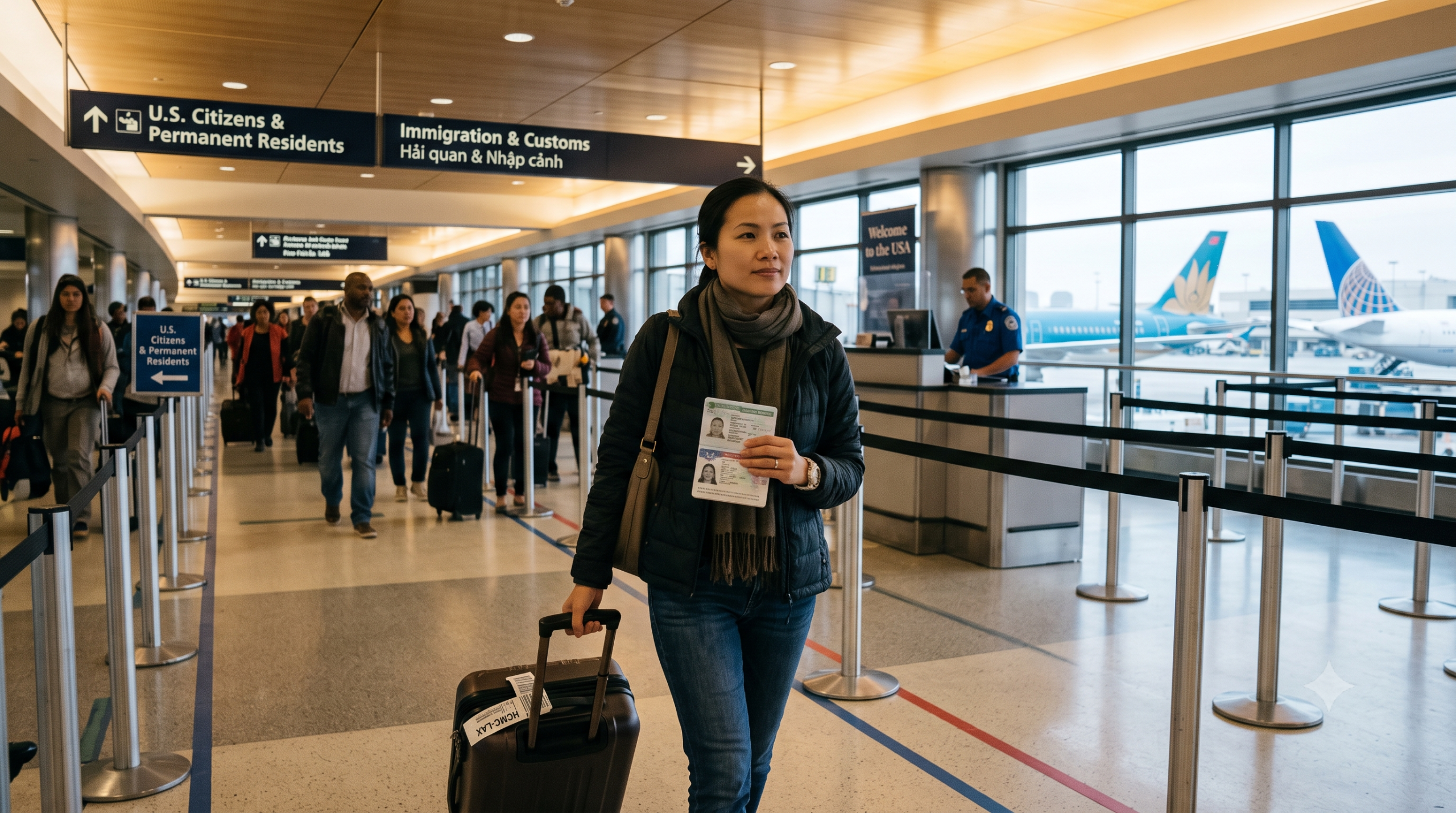
US Permanent Residents, commonly known as Green Card holders, frequently travel between the United States and international destinations like Vietnam for family visits, business operations, or personal affairs. However, staying abroad for too long can endanger your permanent resident status or cause severe legal issues at port-of-entry checkpoints.
U.S. Citizenship and Immigration Services (USCIS) and U.S. Customs and Border Protection (CBP) strictly monitor international travel duration for Green Card holders. This comprehensive guide breaks down critical timeframes, legal solutions, and step-by-step procedures to safeguard your Lawful Permanent Resident (LPR) status.
Key Travel Timeframes Every Green Card Holder Must Know
The length of time you spend outside the United States directly determines the level of scrutiny by border officers and the travel documents required before departure.
-
Absences Under 6 Months (The Safest Zone): This is the ideal and safest travel duration. You do not need a special re-entry permit. Upon return, CBP entry procedures are straightforward, and officers rarely question your travel purpose or permanent intent.
-
Absences Between 6 Months and 1 Year (The Caution Zone): You face an increased risk of triggering abandonment suspicions. While a Re-entry Permit is not strictly required, CBP officers possess the authority to conduct detailed interviews to verify your ties to the U.S. Furthermore, absences exceeding 180 days break your continuous residence, delaying naturalization eligibility.
-
Absences of 1 Year or Longer (The Danger Zone): Leaving the U.S. for a year or longer automatically renders your Green Card invalid for re-entry without auxiliary authorization. You must obtain a Re-entry Permit (Form I-131) prior to leaving. Without it, airlines will deny boarding, or CBP may initiate removal proceedings at entry.
Legal Solutions for Common Travel Scenarios
Depending on your planned duration abroad, specific legal remedies must be deployed to preserve your permanent resident status.
1. Planned Travel Exceeding 1 Year The mandatory legal solution is to apply for a Re-entry Permit by filing Form I-131. You must file the application and complete biometrics while physically present inside the United States. A Re-entry Permit is valid for up to two years and cannot be renewed or extended from outside the country.
2. Overstayed Past 1 Year Without a Re-entry Permit If unforeseen circumstances—such as severe illness, natural disasters, or travel restrictions—prevent your return within 12 months, standard entry is disallowed. Your sole legal remedy is applying for an SB-1 Returning Resident Visa at a U.S. Embassy or Consulate. You must prove that your prolonged absence resulted entirely from unavoidable circumstances beyond your control.
3. Green Card Expiring While in the U.S. If your Green Card expires before a replacement arrives, file Form I-90 and schedule an appointment at a local USCIS field office to secure an ADIT Stamp (Temporary I-551) directly on your valid passport. Never depart the U.S. with an expired card without this temporary proof of status.
Step-by-Step Application for a Re-Entry Permit (Form I-131)
For permanent residents planning extended overseas stays lasting 12 to 24 months, securing a Re-entry Permit is essential.
-
Step 1 – File Form I-131: Complete and submit Form I-131 to USCIS while you are physically present within U.S. territory.
-
Step 2 – Complete Biometrics Appointment: Attend the required biometrics appointment (fingerprinting and photo) at a designated Application Support Center (ASC).
-
Step 3 – Receive the Document: After biometrics completion, you may depart the U.S. The approved permit can be mailed to your U.S. home address or dispatched to a U.S. Embassy/Consulate abroad for pickup.
Crucial Note: You must remain inside the U.S. through the completion of your biometrics appointment. Departing prior to biometrics results in the automatic denial of your I-131 application.
How to Prove Unbroken Ties to the United States
Even on shorter trips, CBP officers may question your residence intent if you travel abroad frequently. Always maintain documentation proving strong, continuous ties to the U.S.:
-
Financial & Tax Records: Timely federal and state income tax filings (Form 1040), active U.S. bank accounts, and active credit cards.
-
Housing & Real Estate: Active residential leases, utility statements, mortgage papers, or property ownership deeds in your name.
-
Employment & Family Links: Employment contracts, approved leave documentation, valid state driver’s licenses, and proof of immediate family members residing in the U.S.
Emergency Protocol: What to Do If You Overstay Abroad
If an unexpected emergency delays your return past the legal limit without a Re-entry Permit, follow these action steps:
-
Do Not Attempt Unlawful Travel: Avoid purchasing flights to the U.S., as carriers will deny boarding once your entry documentation shows invalidity.
-
Schedule an Embassy Appointment: Book an urgent SB-1 Returning Resident Visa interview at the U.S. Embassy or Consulate in your resident country.
-
Compile Evidence: Assemble medical records, government notices, or official documentation proving that your delay resulted from unavoidable conditions, alongside proof that you always intended to return to your primary home in the U.S.
Understanding complex border regulations and proactively preparing travel paperwork guarantees the safety of your Green Card status, ensuring seamless transit between international destinations and your home in America.
💰 Service Fees EB-2 NIW at KosamSolutions
KosamSolutions provides a transparent, all-inclusive EB-2 NIW service with a 100% refund guarantee if the petition is denied.
-
NIW for Research/Academic Profiles: $8,000
-
NIW for Other Professional Profiles: $10,000
-
Includes free RFE (Request for Evidence) support and initial profile assessment.
-
USCIS government fees (I-140, I-485, or DS-260) are paid directly to ensure transparency.
👉 View Details: EB-2 NIW Green Card Service
💰 EB-3 Service Fees at KosamSolutions
KosamSolutions is committed to providing EB-3 immigration services with a transparent financial roadmap, ensuring complete peace of mind.
-
Total Service Fee: 20,000 USD
-
Payment Plan: Divided into 04 flexible installments, allowing you to pay based on the actual progress of your file.
-
Guarantee Mechanism: “Pay as you Progress” – Clients only pay the next installment once the previous stage has been successfully approved by the relevant authorities.
Note: Government fees (USCIS) such as I-140 filing, I-485 filing, or NVC processing fees will be paid directly to the agencies as per legal regulations to ensure absolute transparency.
👉 View details at: EB-3 Green Card
📞 Free 1-on-1 Consultation
🌐 Website: kosamsolutions.com
✉️ Email: info@kosamsolutions.com
☎️ +1-772-341-1152 (USA) | +84-985-990-459 (Vietnam)
⭐ About the Founder – Nguyen Hong Phuong
KosamSolutions (a subsidiary of KOSAM LLC) was founded and is led by Dr. Nguyen Hong Phuong – a scientific expert who successfully obtained his EB-2 NIW Green Card and now applies his first-hand experience to help clients achieve similar immigration success.
Academic Background & Position:
Dr. Nguyen Hong Phuong holds a Ph.D. in Biomedical Science & Technology and currently serves as a Scientist at Indiana University, USA (since January 2023).
Major Achievement:
He is a recipient of the NIH National Research Service Award (2024–2026), one of the most prestigious research funding programs awarded by the U.S. Government.
Professional Review Role:
Dr. Nguyen Hong Phuong also serves as a Manuscript Reviewer for international academic journals. This role directly demonstrates his recognized authority in evaluating the work of other experts — an important criterion in EB-2 NIW immigration petitions.